Pages

Showing posts with label Tolkien and Lewis. Show all posts

The Tolkien Nerd's Guide to The Hobbit

Peter Jackson’s blockbuster movie draws upon stories behind stories behind stories, just as J.R.R. Tolkien’s original works did. 


By Rachel Nuwer 

http://www.smithsonianmag.com
January 3, 2013

For readers of The Hobbit, which became an almost overnight classic following its 1937 debut, the new movie may elicit some puzzlement. Seemingly extraneous flourishes clog up what many remember as a simple fairy tale, and random characters appear at every twist and turn throughout Middle Earth.

Yet those fans who went on to immerse themselves in J.R.R. Tolkien’s wider lore will find inspiration. For the most part, director Peter Jackson does not exercise an extra heaping of artistic license. Rather, Jackson—reportedly something of a nerd himself—borrows from the larger Tolkien literature to create a richHobbit tableau.

“Jackson knows the lore pretty well and wanted to bring that larger material in there wherever he could,” said Michael Drout, an English professor at Wheaton College who founded the academic journal Tolkien Studies and edited the J.R.R. Tolkien Encyclopedia. It’s this so-called textuality—or texts behind texts behind other texts—that lends Tolkien’s work the air of reality, he said, and which Jackson seeks to capture in his films.

Jackson isn’t free to tap into any detail he wants from Tolkien’s wider works, however. “He had a very difficult task in that the movie rights extend only to The Hobbit and Lord of the Rings,” said John Rateliff, an independent Tolkien scholar and author of The History of the Hobbit. “He’s well aware that there’s a great deal more material set in that world, but contractually not allowed to use that material in the movies.”

More information about some of the plot threads from The Hobbit movie appear in Unfinished Tales(published posthumously by Tolkien’s son, Christopher, in 1980), for example, and The Silmarillion (also published posthumously, in 1977), but Jackson can only hint at the content of these rich texts.

Throughout the film, Jackson tiptoes around this problem, alluding to the larger Tolkien universe when he can. For instance, the mysterious blue wizards, who Gandalf briefly mentions to Bilbo in the movie, are identified by name only in Unfinished Tales, hence Gandalf conveniently “forgetting their names” to spare Jackson a potential lawsuit.

Similarly, while Hugo Weaving’s elf lord of Rivendell, Elrond, recognizes that one of the swords recovered from the troll cave hails back to the goblin wars and once belonged to the king of Gondolin, an Elven city that fell to darkness, he fails to mention the king’s name, Turgon, and does not add that Turgon is actually his own great-grandfather. These details come from The Silmarillion and The Book of Lost Tales(published posthumously, in 1983 and 1984). “Elrond could have quite easily have said, ‘Hey, thanks for bringing that back, we wondered what came of that sword over the last 7,000 years,’ but he doesn’t,” Rateliff said.
B
At one point, Jackson edges dangerously close to the fine line of intellectual rights. “The Quest of Erebor,” a story contained in Unfinished Tales, retells the opening chapter of The Hobbit from Gandalf’s point of view. In it, Gandalf justifies his uncanny attraction to Bilbo, a hobbit with “a love of tales” and “eagerness in his bright eyes.” In the film, Gandalf chidingly asks when Bilbo became more interested in china and doilies than in adventure, mirroring those lines from Unfinished Tales. “I wonder if the Tolkien estate will sue over it,” Drout said. “They are litigious.”

Some of the other references are easy to spot, like Frodo’s appearance at the beginning of the The Hobbitharkening back to The Fellowship of the Ring. Others are more cryptic, however. With Jackson's obfuscation about where the many threads came from, it would be easy for even the mild Tolkien fanatic to get confused. Recognizing some of these twists may help dubious fans be more supportive of Bilbo’s tri-installment cinematic journey—and also appreciate Jackson’s own celebrated nerdery.
(See the full-version infographic of where these plot points came from)
Azog the Orc
The big bad from the first movie, for example, is only briefly mentioned in The Hobbit, but more devoted readers recognized this scene from Appendix A of The Lord of the Rings (the appendices are found at the end of The Return of the King, the third book in the trilogy): a battle between orc and dwarf raged at the east gate of Moria. The dwarf prince Thorin, grandson of the King Under the Mountain, received a mighty blow, cleaving his shield in two. Taking up a protective oak branch in its stead, Thorin began pummeling his foes, earning him the moniker Thorin Oakenshield.
Still, Jackson doesn’t get it exactly right. This business of Thorin amputating the arm of Azog, the albino orc king, for example, is poppycock so far as the books are concerned. According to Tolkien, Azog first brutally murders Thorin’s grandfather in a one-on-one encounter, and there’s no arm amputating or all-consuming vendetta following the dwarf-verus-orc showdown—which Azog does not survive. “I was calling Azog “Mobi-Orc,” like a cross between Moby Dick and Captain Ahab,” Drout said of his reaction while watching The Hobbit. “He’s got the missing limb and is after his enemy like Ahab is after the whale.” 
Dol Guldur and the Darkness
One of The Hobbit’s more mysterious characters was the Necromancer, described only as a dark sorcerer of unknown origins.
Elrond describes “a time of watchful peace” after the first fall of Sauron and the taking of the One Ring, depicted in the battle with Isildur in the Fellowship of the Ring movie. But a darkness may be gathering at Dol Guldur, “the hill of sorcery” in Mirkwood forest where the Necromancer reportedly takes up shop. Radagast confirms these rumors by producing the Witch King's sword. These details (save the sword—that’s a Hollywood addition) mostly took place offstage in Tolkien’s The Hobbit, but Jackson weaves them into his version.

One other discrepancy exists, however: in Tolkien’s books, Mirkwood forest fell to darkness about 2,000 years before Bilbo’s journey, but for dramatic effect Jackson moved those events up to present day. Unlike the map depicted in The Hobbit (the book), Thorin’s version in the movie reads “Greenwood the Great” in place of “Mirkwood,” demonstrating Jackson’s attention to detail.
The White Council
In the Hobbit movie, Elrond and company form a White Council, where Gandalf urges his powerful colleagues to take action against the growing darkness in Mirkwood but wizard Saruman the White shoots him down (not yet turned evil as he is in the earlier film trilogy, but he’s starting to think about it). All of these details are covered in the Lord of the Rings and its appendices, though the Council’s discussions and decision to take action against the Necromancer occur over a period of 490 years in the series.
“At heart, Jackson and his team did a careful job of scouring The Hobbit and The Lord of the Rings for more information about events at the time of Bilbo’s journey,” Rateliff said. “They made good use of these to flesh out events that occur off-stage in Tolkien’s original book, like the meeting of the White Council.”
Radagast the Brown
In the movie, Bilbo and the dwarves face imminent death by an approaching orc horde in the western lands of Eriador (not 100 percent clear since this meeting never took place in the books), when the wizard Radagast the Brown turns up with his sled of rabbits to save the day. Though a Jackson addition, this scene does pay homage to Tolkien with two much-appreciated nerd references. First, Gandalf warns that his friend cannot outrun the wolf-like Wargs, since they are from Gundobad. This seemingly made-up label actually refers to Mount Gundobad, the goblin kingdom to the north of Mirkwood forest. Radagast is not having it, however. “These are Rhosgobel rabbits, I’d like to see them try!” he retorts, making a second reference to his equally obscure homestead of Rhosgobel.
Radagast himself appears only briefly in The Lord of the Rings and The Hobbit when Gandalf mentions his existence. Radagast’s central role in the film—especially the rabbit chase scene, which made Drout wonder “if George Lucas was allowed to touch the script”—is Jackson’s invention.
(See the full-version infographic of where these plot points came from)
Ungoliant the spider
Even Ungoliant, an evil spirit who originated “before the world” and takes the form of a massive spider, gets a brief citation. “Ungoliant is mentioned in The Lord of the Rings in the description of Shelob, ‘last child of Ungoliant,’” Drout said. “But you’d only know the significance of the word Ungoliant if you’d read The Silmarillion.”
Potential plot threads for the next films 
Having a handle on the Tolkien lore can also clue fans in on potential scenes to come in the second and third Hobbit movies. (Warning: for those who prefer to avoid possible spoilers, skip this section!) For example: Will viewers be treated to a flashback of Gandalf wandering into the dungeon of Dol Guldur to recover the map and key for the Lonely Mountain from Thorin’s crazed, imprisoned father, Thráin? Will Galadriel’s forces take on the Necromancer as detailed in the appendices and hinted at in The Hobbit when she reassures Gandalf, “If you need me, call and I will come?” And will Bilbo meet an intriguing 10-year-old named Aragorn in Rivendell on his journey back to Hobbiton?
Of course, some fans will never be satisfied by Hollywood’s stab at Tolkien, no matter how faithful the films are to the original works. When technology reaches the point that Tolkien zealots can produce their own movies, however, this may change. “Some nerdy person like I was when I was 14 will sit in a basement for three years and come out with a film that perfectly renders everything,” Drout predicted. “At that point, there will be nothing that intellectual property lawyers can do to stop it.”


Why J.R.R. Tolkien’s Enduring Popularity Is a Cause for Hope in Our Popular Culture

By David P. Goldman
PJ Media
http://pj media.com
December 16, 2012


Peter Jackson’s first of three “Hobbit” films took a thrashing from the critics, who disliked the effect produced by the new 48-frames-per-second projection system. This makes everything a bit too clear, a bit too smooth, such that sets and costumes seemed artificial to some. It is off-putting at first. Halfway through the film, though, I suddenly thought, “This is the way I saw the world when I was a child!” There are many wonderful things about Jackson’s film, of which the choice of Martin Freeman as Bilbo Baggins stands at the top of my list; unlike the listless Elijah Wood, a boy playing the role of the middle-aged Frodo in the “Rings” trilogy, Freeman is a grown-up. He is a master of English understatement but also an actor of great range, and he carries the film brilliantly. As in the “Rings” trilogy, the sets and settings are marvelous. Especially gratifying was the inclusion of many of Tolkien’s poems with affecting settings by Howard Shore.

J.R.R. Tolkien’s enduring popularity is cause for hope in popular culture. He did not write fantasy so much as roman Ă  clef about the past and future of the West. His Hobbits are the English standing against totalitarian aggression — the two towers of Berlin and Moscow — with decency and courage. “Alone among 20th century novelists, J.R.R. Tolkien concerned himself with the mortality not of individuals but of peoples. The young soldier-scholar of World War I viewed the uncertain fate of European nations through the mirror of the Dark Ages, when the life of small peoples hung by a thread. In the midst of today’s Great Extinction of cultures, and at the onset of civilizational war, Tolkien evokes an uncanny resonance among today’s readers,” I wrote when the first of the Rings films appeared. I am no maven where Christian literature is concerned, but Tolkien’s theological depth impressed me:
Tolkien is a writer of greater theological depth than his Oxford colleague C S Lewis, in my judgment. Lewis is a felicitous writer and a diligent apologist, but mere allegory along the lines of the Narnia series can do no more than restate Christian doctrine; it cannot really expand our experience of it. Tolkien takes us to the dark frontier of a world that is not yet Christian, and therefore is tragic, but has the capacity to become Christian. It is the world of the Dark Ages, in which barbarians first encounter the light. It is not fantasy, but rather a distillation of the spiritual history of the West. Whereas C S Lewis tries to make us comfortable in what we already believe by dressing up the story as a children’s masquerade, Tolkien makes us profoundly uncomfortable. Our people, our culture, our language, our toehold upon this shifting and uncertain Earth are no more secure than those of a thousand extinct tribes of the Dark Ages; and a greater hope than that of the work of our hands and the hone of our swords must avail us.

The heart of the story is the game of riddles played by Bilbo and Gollum deep inside the Misty Mountains. Tolkien is the anti-Wagner, and his “Rings” novels (a trilogy with a prologue) re-write Richard Wagner’s insidious Ring Cycle (trilogy with prologue). Readers who listen to Wagner should be aware, first, that there are many bad reasons to like it, and that they can be cured of this harmful habit by reading this article. Tolkien has a lark with the riddles game played by the dwarf Mime and the god Wotan at the end of the second act of Siegfried; their pompous mythologizing becomes the hilarious, frightening banter of Gollum and Bilbo. Martin Freeman and Andy Serkis, assisted by Jackson’s special effects, do brilliantly. That single sequence is worth the price of admission.

Jackson had a difficult task at hand: The Hobbit is a children’s tale that nonetheless sets up the events leading to the later novels. Jackson and his colleagues effectively integrated background from Tolkien’s Middle Earth histories to establish context and continuity, and in some cases added inventions of their own. Some of these, for example the appearance of the wizard Radagast, work quite well (and are consistent with Tolkien’s story). And the Three Stooges routine performed by the three trolls was a permissible aside, much in the spirit of the book. Others, notably the entirely invented character of an Orc leader with a grudge against the dwarves, are generic Hollywood claptrap. Those are not minor flaws in a work that for the most part is brilliantly conceived and executed. Nonetheless the film should help keep Tolkien’s wonderful story in the mind of the public. Considering all the other stories we have to hear, that is a comfort.
****
Cross-posted from Spengler

Film Review: 'The Hobbit: An Unexpected Journey'

Ring Cycle

By Anthony Lane
The New Yorker
December 17, 2012


Bilbo Baggins (Martin Freeman) and Gollum in Jackson
Bilbo Baggins (Martin Freeman) and Gollum in Jackson’s latest Tolkien adaptation. Illustration by Ron Kurniawan.
The subtitle of “The Hobbit,” written by J. R. R. Tolkien and published in 1937, is “There and Back Again.” Crisp, decisive, and comforting, like the book. The first part of Peter Jackson’s “The Hobbit”—a three-part screen adaptation—is subtitled “An Unexpected Journey,” though that does little justice to the result. Had Jackson been more accurate, he would have called it “Not Quite There Yet,” or “Still Some Way to Go.”
The story has the simplicity of folklore, but the straightness of the narrative keeps arriving at moral crossroads. Thus, when Gandalf the wizard (Ian McKellen) turns up at the house of Bilbo Baggins (Martin Freeman), the hobbit in question, and returns the next day with thirteen dwarves, who invite Bilbo to come and steal gold—or, as they believe, reclaim it—from a dragon far, far away, and to receive a share of the plunder, our hero is faced with an elemental choice: stay or go? Rest in the consolatory rhythms of hearth and home, marked out by meals and seasons, or break the pattern and take the unknowable risk? As Gandalf says to Bilbo, “The world is not in your books and maps. It’s out there!”—a sly gibe, which casts an eye not just on hobbitry but on Tolkien, who had fought and seen comrades die in the First World War, and who, from 1926, preferred to ensconce himself in North Oxford, amid the book-lined walls of his own head. The world was in there.
Bilbo, of course, takes the plunge, and the merry band sets forth, toward the obstacle course of dangers that Tolkien devised. There is a trio of loutish trolls, cannibalistic by choice, but as vulnerable as vampires to the light of day; a huge subterranean fiefdom of goblins, although that is a word we hardly hear in the film, which settles on “orcs,” a less Hogwartian term; and a company of wargs—half wolves, half paparazzi—that crouch and bay at the foot of a pine tree, upon whose boughs the treasure-hunters perch. And there, more or less, the film concludes. If anything, I would have preferred Jackson—who, however noisy his films, has a dash of silent-movie showmanship about him—to be even more unabashed in his melodrama, leaving Bilbo to teeter on the brink. After all, Tolkien himself was a surprising master of brinksmanship, and “The Hobbit,” being infinitely brisker than “The Lord of the Rings,” measures out its plot in narrow squeaks. It is populated largely by child-size men: an ideal conceit, allowing child readers to dream of manly deeds and adult readers to recall, however dimly, what it once meant to have a pulse that raced like a child’s.
But there was more to the novel than that—something that squirmed in the murk of its motivations. In “The Lord of the Rings,” the errand of Frodo, though epic in execution, was plain enough: to destroy what would, in the wrong hands, cause irreversible harm. It was like stopping the Nazis from building an atomic bomb. But what the dwarves want, in the pages of “The Hobbit,” is gold, and their lust for it corrodes the quest and tarnishes its valor. That is what lusts do. Tolkien, a devout Catholic, who deplored the vanishing of the Latin Mass, believed in the existence of evil and in the struggle to be delivered from its claws. It is there in every shimmering scale of Smaug, the dragon; deprived by a mouse-quiet Bilbo of a single precious cup, he falls, Tolkien writes, into “the sort of rage that is only seen when rich folk that have more than they can enjoy suddenly lose something that they have long had but never used or wanted.” Ouch. The dwarves, in their small way, are no less possessed, and the joke is that a hobbit, who wishes nobody ill, should help to lead them into temptation. So many twists of the spirit, in such little space. In my old paperback, Tolkien gets the whole thing done in two hundred and eighty pages, nineteen chapters in all. And how far has Jackson travelled, after almost three hours of cinema? The end of Chapter 6. The corrosion has yet to bite.
There is much to relish here. Martin Freeman, compact and affable, is a snug fit in the difficult role of Bilbo. He is especially adept at hesitation, cocking his head like a sparrow and speaking hurriedly to others, as if trying an idea out on himself. This makes him an excellent foil—better and less wide-eyed than Elijah Wood was, in “The Lord of the Rings”—to McKellen’s Gandalf, with whose lengthy, growling vowels we are already familiar. No less welcome is Richard Armitage, scarcely known here, although he has throbbed hearts on a regular basis on British TV; he now pulls off the task, deemed impossible by every expert on Middle-Earth, of making a dwarf seductive. To be honest, the dwarves come across as a jumble of Brueghel faces, lit with grins, scrunched by scowls, and fronted by bulbous conks; only Armitage, as Thorin Oakenshield, the leader of the pack, earns consistent dramatic attention, and he brings the rumpus of the early scenes to a beautiful halt as he pauses to croon, in a yearning baritone, an anthem of dwarf-desire—“Far over the misty mountains cold.” Not before time, it must be said; Jackson has allowed one tea party to linger like a five-course meal, and such blithe elastication is the root of the movie’s fault.
No one could quarrel with Jackson’s scheme to transform the three volumes of “The Lord of the Rings” into a trilogy of films. It was an obvious arrangement, crowned by “The Return of the King” and its eleven Academy Awards—“One for each ending,” in the words of Billy Crystal, our host on Oscar night. If Jackson couldn’t bring himself to bid the franchise farewell, his problem, with “The Hobbit,” is the opposite: how to get going? Like George Lucas, with “The Phantom Menace,” he is constructing a six-film saga in peculiar order. We thus begin not with backstory but, this being Tolkien, with backmyth—the legend of Smaug and the devastation that he wrought long ago. From here, we pass to the aging Bilbo (Ian Holm), and to his recitation of what befell him sixty years before; and from there, at last, we reach the point at which the novel starts. In all, it is three-quarters of an hour before the youthful Bilbo departs, adventure-bound. Because of that delay, there is something doughy and whimsical about the proceedings, as if we were present at the spinning of a yarn.
Still to come, and interrupting the flow, is a layover in Rivendell, the stronghold of the Elves; an aery cameo by Cate Blanchett, as Galadriel (who is not in the book); and a dreadful, unfunny diversion into the doings of another wizard, Radagast the Brown (Sylvester McCoy), who drives a rabbit-powered sled and goes cross-eyed when he scores a hit of Gandalf’s bong. Jackson’s “Lord of the Rings” had the air of an urgent report, borne in desperation from a distant land. His “Hobbit” has many thrills, and rather too many spills, but it never sheds its bouquet of mere moonshine.
Mind you, what a shine. “An Unexpected Journey” was shot in 3-D and filmed at forty-eight frames per second, as opposed to the standard twenty-four. This sounds miraculous, and you will indeed notice and marvel at the difference, but only if you happen to be a snowy owl who likes watching voles from a hundred and fifty yards. The rest of us will be reminded of high-definition television—better known, in my household, as a reason to avoid viewing films on TV, unless they contain characters named Woody and Buzz. HD has the unfortunate effect of turning every film into what appears to be a documentary about a film set, not just warts-and-all but carefully supplying extra warts where a wart has no right to be. There is something awry in the idea that Tolkien’s wondrous inventions—an entire history and landscape, plus trees of unknown languages, grown from one man’s fancy—should be transmitted through a medium newly and utterly bent on realism. When the imaginary is presented as fact, hard and hypervisible, right down to the popping buttons of a waistcoat, does the magic not drop off?
For pathos, though, we still have Gollum, the damned and slimy soul (voiced again by Andy Serkis), who lurks in the dark and loses what he loves. Bilbo finds it: “His hand met what felt like a tiny ring of cold metal lying on the floor of the tunnel.” That is the account given by Tolkien, who knew that turning points were all the more momentous for being unadorned, but Jackson, with so much room to spare, cannot dare to underplay the crux. Instead, before Bilbo stumbles upon the ring, we see it slip from Gollum’s safekeeping, tumble in refulgent slow motion, and, on impact, give a resounding clang. (If Jackson ever films “Othello,” wait for Desdemona’s handkerchief to hit the ground like a sheet of tin.) “All good stories deserve embellishment,” Gandalf says to Bilbo before they set off, and one has to ask whether the weight of embellishment, on this occasion, makes the journey drag, and why it leaves us more astounded than moved. And yet, on balance, honor has been done to Tolkien, not least in the famous riddle game between Bilbo and Gollum, and some of the exploits to come—dwarf-wrapping spiders, a battle of five armies, and the man who turns into a bear—will surely lighten the load. As Bilbo says, nearing the end of the book, “Roads go ever ever on.” Tell me about it. ♦

Boyens: Del Toro's 'Hobbit' would've been 'amazing'


Philippa Boyens is one of the writers of Peter Jackson’s new J.R.R. Tolkien adaptation, “The Hobbit: An Unexpected Journey,” and a longtime collaborator with Jackson and his creative and life partner Fran Walsh. (Kirk McKoy / Los Angeles Times)
Mary McNamara
Los Angeles Times
December 7, 2012
“There and Back Again” is the subtitle of J.R.R. Tolkien’s “The Hobbit,” and it would certainly serve handily for a biography of many of those involved in taking the book to film, though none perhaps as well as Philippa Boyens.
Asked one day in 1997 if, as a fan of J.R.R. Tolkien, she might have any interest in helping out friends and fellow New Zealanders Peter Jackson and Fran Walsh adapt “The Lord of the Rings” for film, Boyens, a former teacher and then executive director of the New Zealand Writers Guild, shrugged and said, “Sure, why not?”
“I figured it would last a couple of weeks,” she says now, laughing at the memory, “maybe a month.”
Instead she, like so many Tolkien characters, was swept away on a life-changing adventure, down roads long and sometimes perilous. Fifteen years later, she is an Oscar-winning screenwriter and producer, part of one of the most successful collaborations in film history and proof that a third wheel (Walsh and Jackson are also life partners) is a good thing to have if you’re going to wander over terrain as varied as the “Lord of the Rings” franchise, “King Kong,” “The Lovely Bones” and now “The Hobbit: An Unexpected Journey,” which arrives in theaters Friday.
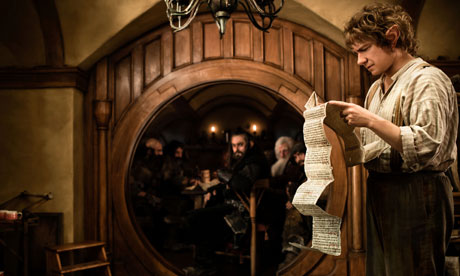
Martin Freeman stars as Bilbo Baggins in “The Hobbit: An Unexpected Journey.” (New Line Cinema / MGM / Warner Bros.)
When New Line and Warner Bros. initially decided to make two films from Tolkien’s first book — a child’s tale that turned out to be the prelude to the author’s three-book epic — Guillermo del Toro signed on as director. Boyens, along with Walsh and Jackson, took up their staffs, cloaks and keyboards, returning to Middle-earth as co-writers and producers.
The four began outlining Del Toro’s vision for the book, but after waiting almost two years for rights issues to be resolved, Del Toro left the project. Jackson eventually accepted the director’s chair, and he, Walsh and Boyens began again.
“I would love to have seen the films Guillermo would have made,” Boyens says frankly. “It would have been amazing. And he certainly helped us by bringing fresh eyes to the Middle-earth because, of course, the biggest issue was making sure we weren’t remaking ‘Lord of the Rings.’
“In some ways it was easier, though, starting again for Pete. We work in a different way, very fluid, very flexible.”
She and Walsh do most of the preliminary writing, although as with “Lord of the Rings,” scenes are rewritten even as they are being shot or sometimes after. “Pete incorporates new ideas from everyone, he likes to work with the actors, it was all quite familiar.”
But, as Boyens says, familiarity was as much an obstacle as a boon. “If we hadn’t made ‘Lord of the Rings,” she says, “this would probably be a different film — the book is aimed at a much younger audience. But this world now exists, people are familiar with it so, as Pete put it, we were going back on location to Middle-earth.”
Ian McKellen as Gandalf and Richard Armitage as Thorin Oakenshield in “The Hobbit: An Unexpected Journey.” (New Line Cinema / MGM / Warner Bros.)
The landscape isn’t the only thing that’s familiar; audiences now also have a certain expectation from the inhabitants — hobbits and dwarfs, wizards and elves, and above all, Gandalf, played now, as then, by Ian McKellen.
The ultimate decision to make three films of the relatively slender tale was in large part because of the writers’ decision to follow Gandalf on the mysterious journey he takes in the middle of “The Hobbit.”
“In the book, Gandalf just disappears, you know,” Boyens says. “And at the time it was written, you don’t know what he does or where he goes. But now we know, the audience knows. It’s a wonderful story, and we have such a powerful character in Gandalf it was a no-brainer to tell it. And any day you spend working with Sir Ian is a good day.”
Indeed, despite having spent years writing and prepping for filming of “The Hobbit,” Boyens wasn’t quite prepared for the emotional nature of her return to Middle-earth until she met with McKellen for a costume fitting.
“There was really nothing much new, a different scarf or something, and I wasn’t really thinking about it and I rounded a corner and there was Gandalf peering at me from under the brim of his hat,” she says. “I hadn’t seen him in 10 years, you know, and it really hit me. We’re back.”
The young Bilbo Baggins of “The Hobbit” is played by Martin Freeman rather than Ian Holm, who portrayed the older version of the character in “Lord of the Rings,” but McKellen isn’t the only actor joining the reunion; Holm is too, setting up the story in flashback.
As with the three films of “Lord of the Rings,” the writers dipped into Tolkien’s lengthy appendixes to smooth or flesh out the cinematic narrative. And so in this now three-film version of “The Hobbit,” Galadriel (Cate Blanchett), Elrond (Hugh Weaving) and Legolas (Orlando Bloom) appear, as do Saruman (Christopher Lee) and Gollum (Andy Serkis).
“Talk about someone who hasn’t aged,” Boyens says with a laugh, “Cate Blanchett is even more beautiful than she was, and Orlando looks younger somehow. It’s totally unfair.”
With Jackson “bouncing around in regular form,” there was a certain dĂ©jĂ  vu to the set at times, she says, but there were plenty of new faces; in addition to Freeman’s Bilbo, there are 13 dwarfs, including Richard Armitage as the impressive and at times imperious Thorin Oakenshield.
“Thorin is a very powerful character in the film,” Boyens says, “and a very difficult one because he is so complicated.”
Everyone was aware of the essential challenge — to revisit a familiar land but at a slightly earlier time and to tell a very different sort of story.
“A lot of it came down to casting the right person for Bilbo,” she says. “Because there’s a whimsy to ‘The Hobbit’ that is not easily translatable.”
Then there’s the structure of the story, which is so episodic it could have easily felt like a TV miniseries and doesn’t have the sense of higher purpose required by an epic, which if you’re going to make three films, “The Hobbit” had to become.
“It’s not a noble quest to begin with,” Boyens says, “it’s a quest for treasure. And Bilbo is not a traditional hero — he doesn’t kill the dragon, some guy from out of nowhere does. Bilbo is heroic but not in that way.”
She says the first part of the trilogy hews close to the book, though with a darker tone that will then carry on to the other films. Liberties are taken, but the three writers have learned that though they will never be able to satisfy the Tolkien purists, most fans understand that the films are versions of the books and judge them as such. (It remains to be seen how audiences will respond to the new 48-frames-per-second technology that Jackson employed for the shoot, which is designed to create a hyper-real look.)
Which isn’t to say that Boyens doesn’t have a few bones to pick with final edits. In the case of “Lord of the Rings,” she went nine rounds trying to figure out how keep the character Tom Bombadil in the film (she couldn’t), and in “The Hobbit” there is at least one scene she “just loves” that she is pretty sure won’t make the final cut.
“I would love to have seen the films Guillermo [del Toro] would have made,” Boyens says. (Kirk McKoy / Los Angeles Times)
Even her youngest child’s film debut hit the cutting-room floor fairly early. In the “Lord of the Rings” films, the Jackson and Boyens children all had small roles, as hobbits and children of Rohan and Gondor. In “The Hobbit,” Boyens’ daughter plays a dwarf.
Her now-3-year-old son, Isaac, also played “the cutest little hobbit baby you’ve ever seen,” but, alas, his big moment came in a scene Jackson did not think was crucial.
“My child got cut,” Boyens says, a note of good-humored outrage in her voice, “by his own godfather.”
– Mary McNamara
Follow us on Twitter: @LATHeroComplex
RECENT AND RELATED

Comments

There are no comments posted yet. Be the first one!

Post a new comment

Why Tolkien was a fine modern artist


The Lord of the Rings and Hobbit author was also a gifted illustrator, creating abstract and subtly beautiful works of art
By Jonathan Jones
The Guardian
29 November 2012
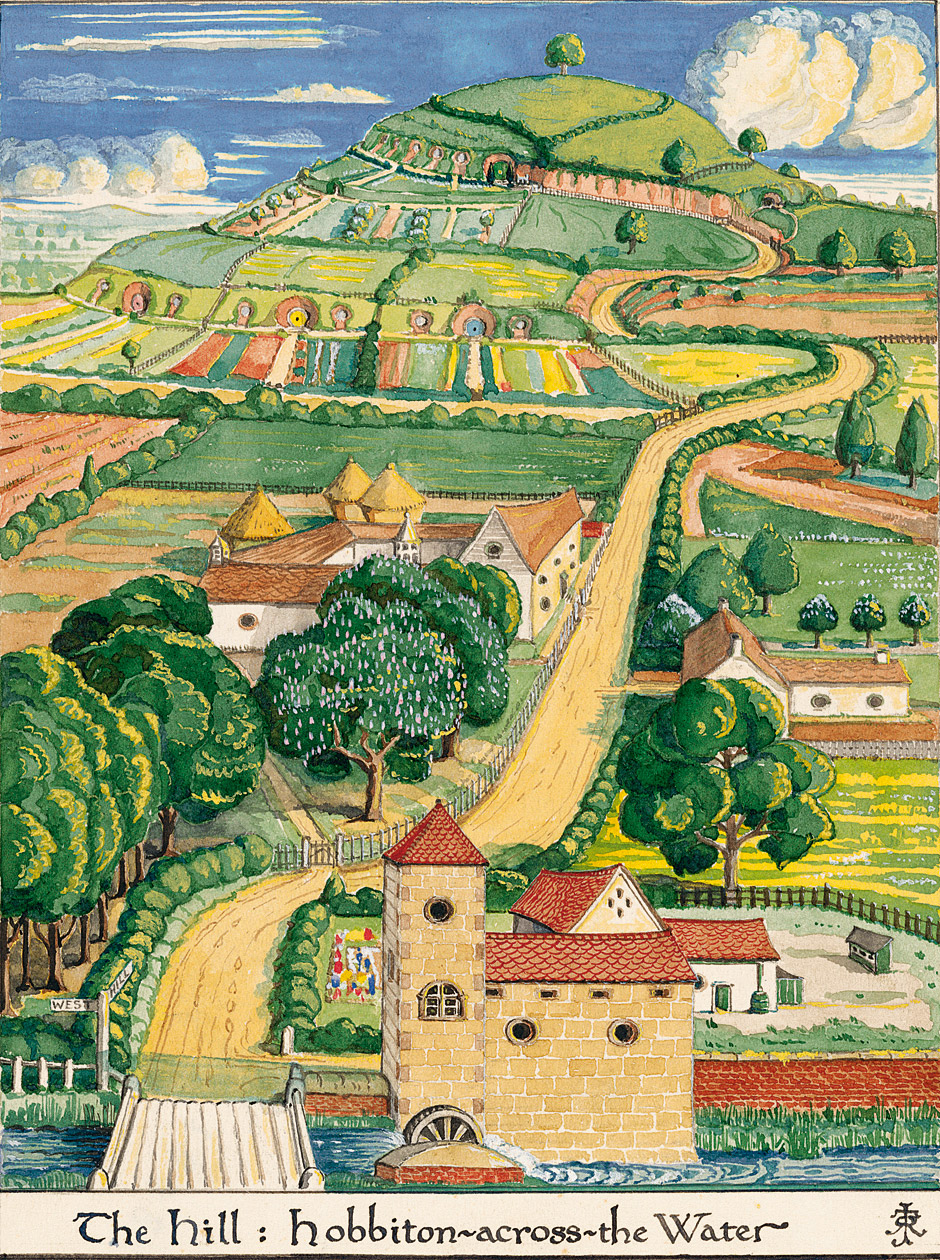
Tolkien's art work for Hobbiton-across-the-waterView larger picture
Sketches of Middle Earth … Tolkien's artwork, from The Art of the Hobbit. Photograph: The Art of the Hobbit
The film series of JRR Tolkien's The Hobbit is unlikely to come anywhere near matching the author's own visualisation of his imaginary world. We know what director Peter Jackson thinks the landscape of Middle Earth is like, from his previous films of The Lord of the Rings, as well as pre-released images from the first instalment of The Hobbit. Jackson's use of location to make the fantastic seem real is impressive. Yet his images are ponderous compared to the ethereal drawings and paintings in which Tolkien pictured places such as Rivendell and the Shire.
Tolkien imagined his otherworld of hobbits, elves and wizards in pictures, as well as words. The Hobbit was first published in 1937. As he wrote it, in the 30s, he made beguiling pictures and designs that map and depict the landscapes through which Bilbo Baggins was to journey.
Tolkien designed the cover for that first edition of The Hobbit. It immediately promises a rich and strange world within: layers of trees in green, white and purple fold over one another towards stylised mountain peaks and the great disc of the sun. Runes are inscribed along the edges of the design. Runic writing is the script of the elves in Middle Earth – but Tolkien did not invent it. Runes were used by the Vikings to inscribe memorials and spells. The Viking connection is telling, for Tolkien's art has a Scandinavian quality. The dreamlike elegance of The Hobbit's original cover is reminiscent of modern northern European art as well as ancient Viking designs.
One artistic cousin of Tolkien is the Russian early 20th-century painterNicolas Roerich, who was fascinated by the journeys of the Vikings into medieval Russia. Roerich's pictures of the Vikings share the intense quality of Tolkein's art. Roerich is most famous for designing the revolutionary ballet The Rite of Spring. The affinity between his vision of The Rite of Spring and Tolkien's images of Middle Earth is striking.
Tolkien, in other words, is a fine modern artist. His vision of The Hobbit in his original illustrations is very different from the bog-standard digitised fantasy art of today. Tolkien's Hobbit pictures are subtle, even abstract. A scene called The Trolls that he drew for The Hobbit depicts a curling, fantastical flame rising amid a nocturnal labyrinth of stippled trees. Hispainting Bilbo Comes to the Huts of the Raft Elves is a misty golden landscape you just want to walk into.
It is this sense of place, of a place so real in his mind that he can map or draw it, that makes Tolkien the greatest of all modern fantasy writers. His beautiful works of art reveal the crystalline eye of his genius.

C S Lewis deserves his place in Poet's Corner

By Alister McGrath
The Telegraph
21 November 2012


Today it will be announced that a memorial to the poet, literary scholar and novelist C S Lewis (1898-1963) is to be placed in Poets’ Corner at Westminster Abbey next November, 50 years after his death. He joins a select group of poets, playwrights and writers to have been buried or commemorated there, including Geoffrey Chaucer and William Shakespeare. I would argue that Lewis certainly merits inclusion among these greats of English literature.
Has he secured his place because he was a poet? He certainly had early aspirations in that direction. Born in Belfast, he hoped to become an “Irish voice” in poetry, with W B Yeats as his model. Yet little came of this aspiration. His first slender volume of verse, Spirits in Bondage (1919), was published under the pseudonym “Clive Hamilton” (Hamilton was his mother’s maiden name). Many of these poems were written while he served as a junior officer in the trenches of northern France during the First World War.
The early poems remain a powerful witness to Lewis’s early atheism, railing against an absent and uncaring God who failed to halt the slaughter the author saw around him. But he never achieved recognition as a “war poet”, like Rupert Brooke and Siegfried Sassoon, who are also commemorated in Poets’ Corner. Indeed, not only did he fail to secure recognition for his war poetry, he was not acclaimed as a poet of any kind, as the lack of interest in his second volume of verse – Dymer (1926) – made painfully clear.
He went on to secure his reputation, rather, as a literary critic at Oxford and Cambridge, offering important assessments of the poetry of others, especially Edmund Spenser and John Milton. He excelled at this task. His work on Milton drew attention to an aspect of his poetry that had been neglected – how it sounded to its readers. Lewis became acutely sensitive to the rhythm of the English language, whether poetry or prose. He never used a typewriter, explaining that the clattering of its keys destroyed his “sense of rhythm”. For Lewis, a fountain pen enabled its user to be attuned to the melody of language.
In the end, the poetic vision that Lewis never quite managed to actualise in his verse was found instead in his prose. Here we find one of the keys to his success as a writer – his ability to express complex ideas in simple language, connecting with his audience without losing elegance of expression. Lewis learnt this skill the hard way, partly through lecturing to aircrews during the Second World War. If you could not express something in simple language, Lewis later declared, it was because you had failed to understand it yourself.
Lewis is one of the best examples of a writer who took pleasure in the art of communication, melding simplicity and elegance in a way few could manage. His popular religious writings – such as The Screwtape Letters and Mere Christianity – combine these qualities, even though they cannot be counted as great literature.
Yet this alone does not explain his inclusion in Poets’ Corner. The real reason he deserves his place is on account of his works of fiction, which captured the imagination of his public, especially in the dark days after the Second World War. Supreme among these are his Chronicles of Narnia, especially The Lion, the Witch, and the Wardrobe (1950).
Although he had no children of his own, Lewis produced a work that captured the imagination of a generation of younger readers. The noble lion Aslan, lord of the mysterious world of Narnia, has become one of the most familiar Christ-figures in English literature. Some, understandably, find the Narnia books problematic on account of the “golly-gosh” language of the Pevensie children, or a suspicion that female characters are allocated subsidiary roles in the narrative. Yet they remain a classic in their field, serving as a model for both Lewis’s literary imitators and critics.
It was not simply that Lewis had written children’s stories that captivated their readers. Lewis developed these stories as vehicles of theological exploration, allowing him to explore sophisticated ideas without compromising the pace of his narrative or losing the patience of his readers. Narnia, Lewis later explained, was about “supposals”. Suppose God did become incarnate in a world like Narnia. What would this look like? More importantly, what would it feel like to be part of this world?
Lewis revealed the imaginative capacity of children’s literature to engage and explore the deepest questions of life, to bring a new quality of engagement to the genre. The writer himself was convinced that he would be forgotten within five years of his death; he would have been taken aback by the renewal of interest in his writings since the Eighties. Surveys now regularly identify him as one of the most significant literary voices of the 20th century. Lewis has made what is probably the most difficult transition an author can hope to make – being read by more people a generation after his death than before it.
Lewis died on the day President John F Kennedy was assassinated. In a speech given at Amherst College four weeks before his death, honouring the great American poet Robert Frost, Kennedy paid a typically handsome tribute to the work of poets and writers. “We must never forget,” he declared, “that art is not a form of propaganda; it is a form of truth.” Lewis would agree. He rightly takes his place among those honoured for their enrichment and expansion of our vision of reality.