Pages

Showing posts with label European History. Show all posts

Doubters and Haters

What drives Barack Obama’s “doubters and haters”?
So asks Obama biographer David Maraniss in a recent op-ed article for the Washington Post. By doubters and haters he means the people who think Obama wasn’t born in the U.S., that he’s a secret Muslim, or that he’s a closet socialist.
He has an answer: “Some of it can be attributed to the give-and-take of today’s harsh ideological divide. Some of it can be explained by the way misinformation spreads virally to millions of like-minded people, reinforcing preconceptions. And some of it, I believe, arises out of fears of demographic changes in this country, and out of racism.”
True enough! Some people are no doubt driven by such motivations and anxieties; “some” is a gloriously accommodating word.
But that hardly settles things. For an essay titled “What Drives the Obama Doubters and Haters,” Maraniss offers no explanation until the last paragraph (the quote above). And even then he offers no evidence, just assertions.
I think Maraniss is a great reporter, and I don’t believe for a moment he is in on a cover-up of Obama’s “real” place of birth or his secret Muslim faith. (Nor do I think either allegation is true.)
As to Obama’s closet socialism, I’ve never found it unreasonable (never mind racist or paranoid) to think Obama’s more comfortable with European-style social democracy (a.k.a. socialism).
Still, let me add two culprits to Maraniss’s list: The first is Barack Obama. The second is the journalistic establishment that worked so hard to get him elected.
As Maraniss demonstrates quite effectively in his book, Barack Obama: The Story, Obama’s identity has long been a cultivated political project. Much of the poetic license — to use a kind phrase — Obama deploys to tell his own story is plausible only to those eager to take him at his word.
Maraniss couldn’t authenticate Obama’s tales of racial hardship as a young man. His grandfather being tortured by the British, the bigotry of his high-school basketball coach? Untrue.
Moreover, Obama’s explanations about the aspects of his past that have managed to become controversies have always seemed insufficient to people not disposed to root for him. Bill Ayers — a former domestic terrorist — was “just a guy living in my neighborhood.” Obama’s word that he wasn’t a member of the radical New Party was enough for the press corps to stop digging for evidence that he was (as reported by my National Review Online colleague Stanley Kurtz). Jeremiah Wright? Only right-wing crazies care about him.
Even Obama’s more recent embellishments about, for instance, being outspent and outgunned in his previous political races strike many people as the sorts of fibs that would create journalistic frenzies if uttered by a Republican.
And then there’s the huge divergence between the president Obama said he would be and the president he’s actually been. In 2008, Obama insisted that he was a unifier, a pragmatist, and a non-ideologue. You don’t have to be a birther or a secret-Muslim conspiracy theorist to feel like that was all a big con job. That’s politics and not deceit (a subtle distinction!), but dismay at how Obama has governed doesn’t amount to racial panic either. And blame for the widespread feeling that we were sold a bill of goods by a cheering press does, in fact, belong to the press.
Yes, Obama also signaled to his base that he intended to be a “transformative” president, a progressive Ronald Reagan. But that message was intended only for his base. Whenever conservatives picked up on those notes — when he said he wanted to “spread the wealth around,” etc. — the immediate response from the Sunday-talk-show crowd was that conservatives were being paranoid for misreading Obama, the pragmatist.
It’s fine to beat up on conspiracy theorists, but journalistic muckety-mucks who are mystified by their ever-shrinking credibility — and profitability — might wonder what they’ve done to fuel a climate of distrust. There’s a reason why ABC’s Jake Tapper is one of the few nonconservative reporters respected on the right: He’s stayed as skeptical of Obama as he was of George W. Bush.
Meanwhile, it’s fascinating how much attention the conspiracy theorists get. It’s almost as if some journalists want to use them as bogeymen to discredit all criticism of Obama. That’s some journalists, not all.
— Jonah Goldberg is editor-at-large ofNational Review Online, a visiting fellow at the American Enterprise Institute, and the author of The Tyranny of ClichĂ©s. You can write to him by e-mail atJonahsColumn@aol.com, or via Twitter@JonahNRO. © 2012 Tribune Media Services, Inc.

'Europe is already falling apart’

Antony Beevor, chronicler of European history, has chilling warnings about the current rise in militant nationalism.

By
The Telegraph
http://www.telegraph.co.uk/
28, May 2012


Nothing I’ve heard from politicians or economists on the world crisis has shivered my spine like an hour spent with the gentle‑mannered historian Antony Beevor, whose mighty new book on the Second World War is making him the pundit of the moment. He does not mean to be alarmist, and that is why the soft warnings in his sunlit garden are chilling.

Of course the rise of the Right in Europe is not the same as the rise of the Right in the Thirties, he soothes. But isn’t it terrifying the way the Greeks are portraying the Germans as Nazis in their popular press, with Angela Merkel in Nazi uniform? There are “far too many jibes” about a Fourth Reich. The weedlike eruption of extremist parties makes him “uneasy” – and if Beevor is uneasy, it probably means the rest of us should be scared witless.
“The great European dream was to diminish militant nationalism,” he says. “We would all be happy Europeans together. But we are going to see the old monster of militant nationalism being awoken when people realise how little control their politicians have. We are already seeing political disintegration in Europe.”
It’s fascinating the way serious historians are being treated as quasi-prophets for the economically bewildered. Tomorrow, Beevor is due to lecture to the Ministry of Foreign Affairs in the Hague on the Second World War and the current euro crisis and he says he is having to change his script daily “as more and more terrifying news comes in”.
“I feel slightly uneasy at the way historians are consulted as if history is going to repeat itself,” he says. “It never does. It is misleading and dangerous to make sweeping parallels with the Second World War. Politicians like Blair and Bush liked to sound Churchillian or Rooseveltian at times of crisis, but the comparisons of Saddam Hussein to Hitler were preposterous. Eden compared Nasser to Hitler and that led us into the Suez disaster.

“It is this compulsion to look backwards at a time of crisis because one’s got no idea of what lies ahead. There is a notion of security that somehow it must resemble the past. It’s never going to. Just because we muddled through in the past doesn’t mean we can automatically muddle through in the future.”

The only similarity between now and the late Thirties, he says unconsolingly, is that the public have not been told the truth about how desperate the situation is because no politician, then or now, dares to spell it out. “One must remember that Churchill was derided and scorned when he warned of the dangers of German rearmament. He could only come to power once war had started. That, I think, is rather alarming.”

Everything is rather alarming seen through the Beevor long lens. There is even drama in his person. He has a lot of silvery hair and leaping black eyebrows. Though his speech is a torrent of pure Queen’s English fluency, in occasional silences he picks at his fingers. Perhaps he is suppressing anxiety.

If so, it can’t be on account of his sales figures. The military historian – of whom it is always joyfully recorded that at Winchester he failed history and English A-level – has sold more than five million books. His most acclaimed, Stalingrad, won the Samuel Johnson prize for non-fiction, the Wolfson history prize and the Hawthornden prize, all in one week in 1999. With the money, he bought a house in Kent that friends like to nickname Schloss Stalingrad or Dunstalingrad. Here, in a pastoral retreat surrounded by sheep and alpacas, he and his wife, Artemis Cooper, do most of their writing. Her biography of Patrick Leigh Fermor comes out in the autumn.

After his non-compliance in formal education, Beevor joined the Army in 1965 and served with the 11th Hussars. On a posting to Wales, he was so bored that he began a semi-autobiographical novel that made him rethink his motives for being a soldier. They were all wrong: he realised he had a big chip on his shoulder about proving himself physically, a legacy of having been bullied as a child. From the age of four to seven he had walked with an armpit crutch, with one leg strapped up behind his back, because of a degenerative disease of the hip.

John Keegan, whose ground-breaking book Face of Battle revolutionised the chronicling of war, had taught him military history at Sandhurst. Once Beevor got into his considerable stride as a writer (he is from a long line of female authors), he found Keegan’s way of looking at history from the bottom up rather than the top down fitted with his own ideas of conveying the fear, chaos and horror of war from a soldier’s perspective. A soldier himself, he already understood the psychology of war.

“I’m not saying every military historian should have been a former soldier – that was the problem in the past – but some military experience is useful, if only to understand that armies are emotional organisations, not the cold mechanical institutions so often portrayed.”

Beevor’s skill is in making big historical events resonate with people through the detail of human experience gleaned from letters, interview transcripts and diaries. “I am not someone who believes I am going to find a historical scoop,” he says. “What I find satisfying is lots of good low-grade material [in Stalingrad’s cellars, lice are seen leaving the dead body of a German to take up residence in one that was still warm], which helps to build the mosaic through detail. I just love the days when you come out of the archives with half a dozen excellent descriptions or poignant accounts of personal experiences.”

Interest in the Second World War was flat when Beevor started his four-year project on Stalingrad. The book was expected to sell 6,000 copies, but flew off the shelves. Berlin: the Downfall 1945, six years later, was another triumph. The resurgence of interest in history was a phenomenon he could never have predicted. “People’s interest in the past had changed. My timing was lucky. Timing is a big percentage in life, in love or anything else.”

Beevor claims there is nothing he likes better than to start a book with an idea and then to realise he was completely wrong. He has no time for historians who are simply out to prove a thesis. Much historical fiction makes him grind his teeth, especially where words and thoughts are put into the minds of real historical characters, as in the Booker prize-winning Wolf Hall by Hilary Mantel. “We are part of an age where there is virtually no distinction between fact and fiction. The failure to distinguish between historical truth and the imagination of the novelist is a danger area. I am not attacking the quality of Mantel’s fiction but I would have preferred it if she had not called the character Thomas Cromwell. My wife does not agree with me. She thinks I am being far too pedantic.”

He was dragged by his daughter, Nella, 22, to see the film of Dan Brown’s novel The Da Vinci Code (“an absolute load of tripe”) on the basis that it was so bad he might find it amusing. On leaving, Beevor heard a man say to his girlfriend: “That really makes you think.”

“So depressing,” he slumps. “I didn’t know whether to laugh or cry. It is frankly grotesque that nearly 50 per cent of the population was persuaded that Mary Magdalene had a child by Jesus and the bloodline continued.” As for Tom Cruise in the 2008 film Valkyrie: “Most people seeing it would have thought it was an accurate account of the July bomb plot, when it was absolute rubbish. Sorry, but the interests of the entertainment industry and the interests of history are fundamentally incompatible.”

He admits to panic that he would drown in the sea of material for his latest book, The Second World War. Copying across information from the archives into skeleton chapters, he would find that he had 110 pages of notes for a single chapter. And yet there is one more massive Beevor analysis of the conflict still to come – about the Battle of the Bulge in the winter of 1944 – before he starts an epic life of Napoleon, followed perhaps by a novel set in 1917‑45. He is 65, and at his present rate of production, that will take him well into his seventies. “I can’t envisage stopping writing,” he says. “My dear father-in-law, John Julius Norwich, is still writing at 82. My God, it really keeps the marbles jangling.”

Antony Beevor’s 'The Second World War’ is available to order from Telegraph Books for £20 plus £1.25 p&p. Call 0844 871 1515 or visit books.telegraph.co.uk. He will be at the Telegraph Hay Festival at 7pm on June 9; www.hayfestival.com

President Obama Shuns Lech Walesa


The Polish Solidarity leader is “too political” for the administration.


By Rory Cooper
http://www.nationalreview.com
June 1, 2012


Lech Walesa was once a trade-union activist. He was often arrested for speaking his mind against Communist oppression behind the Iron Curtain in Poland and for defying the Soviet Union. He was an electrician who, with no higher education, led one of the most profound freedom movements of the 20th century — Solidarity. He became president of Poland and swept in reforms, pushing the Soviet Union out of his homeland and moving the country toward a free-market economy and individual liberty. And President Obama doesn’t want him to set foot in the White House.

According to the Wall Street Journal, Polish officials requested that Walesa accept the Medal of Freedom on behalf of Jan Karski, a member of the Polish Underground during World War II who was being honored posthumously this week. The request makes sense. Walesa and Karski shared a burning desire to rid Poland of tyrannical subjugation. But President Obama said no.

Administration officials told the Journal that Walesa is too “political.” A man who was arrested by Soviet officials for dissenting against the government for being “political” is being shunned by the United States of America for the same reason 30 years later.

Meanwhile, one of the recipients of the Medal was Dolores Huerta, the honorary chair of the Democratic Socialists of America. So socialist politics are acceptable, but not the politics of a man who stood up and fought socialism.

This revelation follows an eruption of outrage in Poland after President Obama referred in his remarks at the Medal of Freedom ceremony to “Polish death camps,” a phrase that Poles have battled since the end of the Cold War. The phrase suggests that Poles were complicit in Nazi concentration camps, which of course is not the case. In fact, Poles were exterminated in the camps.

The White House’s flippant response to the uproar caused the Polish president and prime minister to demand more thoughtful and personal reactions. But White House Press Secretary Jay Carney said Wednesday that the president has no plans to reach out to his Polish counterparts and has shrugged off the outrage in Poland.

Few observers are suggesting that President Obama’s written remarks noting “Polish death camps” were intentionally malicious. The comment was more likely a result of historical ignorance and careless inattention. This is the same ignorance and carelessness that would cause a president to turn away Lech Walesa and label him as “too political.”

Ironically, Lech Walesa shares a distinction with President Obama: They both won Nobel Peace Prizes. Walesa earned his in 1983 after years of fighting for peace and freedom, and being monitored, harassed, and jailed for it. President Obama received his award in 2009. Some may think that this would be enough of a bond for President Obama to set aside political differences for the greater good. But instead, President Obama treated Walesa the same way he treated the 1989 Nobel Peace Prize winner, His Holiness the 14th Dalai Lama, who was ushered out the White House kitchen past piles of garbage in 2010.

The likelihood is that President Obama didn’t want Walesa in the White House because Walesa has made critical remarks toward the president’s policies and in 2010 warned that the United States was slipping toward socialism. But rather than taking the mature and diplomatic path and respecting Walesa’s right to have a differing perspective, Obama chose to shun his lifetime of achievements.

Congratulating Walesa on his Nobel Prize in 1983, President Ronald Reagan said: “For too long, the Polish government has tried to make Lech Walesa a non-person and destroy the free trade-union movement that he helped to create in Poland. But no government can destroy the hopes that burn in the hearts of a people. The people of Poland have shown in their support of Solidarity, just as they showed in their support of His Holiness Pope John Paul II during his visit to Poland, that the government of that nation cannot make Lech Walesa a non-person, and they can’t turn his ideas into non-ideas.”

The White House should not treat President Walesa as a non-person, and they cannot turn his ideas into non-ideas.

— Rory Cooper is director of communications at the Heritage Foundation. You can follow him on Twitter @rorycooper.

WWII Hero Wins Presidential Medal of Freedom

Jan Karski was one of the first to tell the West about the Final Solution.

 
By Deroy Murdock
http://www.nationalreview.com
May 28, 2012

In a White House ceremony Tuesday, President Obama will bestow the Medal of Freedom posthumously on the late Jan Karski, Ph.D. America’s highest civilian honor will go to this Polish-born World War II hero, whose daring deserves universal acclaim.
Speaking April 23 at the Holocaust Memorial Museum in Washington, D.C., Obama praised Jan Karski, calling him “a young Polish Catholic who witnessed Jews being put on cattle cars, who saw the killings, and who told the truth, all the way to President Roosevelt himself.”

I am fortunate enough to have been among Dr. Karski’s students at Georgetown University. I spent my senior fall semester in his “Theory of Communism” class in a brick building called Old North. George Washington once spoke there.

Dr. Karski’s students found him fascinating and often very funny. He also was incredibly modest. Indeed, most of his students had heard little more than rumors about his life during wartime.
As his second-to-last lecture began, we begged him to tell us about his actions during that era. He was reluctant, but we insisted.

Dr. Karski then kept us spellbound for 90 minutes, detailing how he saw the Nazis attack his horse-drawn artillery unit on the morning of September 1, 1939. He fled as the Nazi Blitzkrieg overran the Polish Army. He later was captured by the Red Army as the Soviet Union implemented the Hitler-Stalin pact and invaded Poland from the east.

Jan Karski talked his way out of a troop movement that ended in one of the war’s most notorious atrocities, the Katyn Forest Massacre, in which Russian soldiers slaughtered some 8,000 Polish officers. Having escaped execution there, Karski jumped from a Nazi train soon thereafter as it sped through the Polish countryside.

He fled into the woods and, before long, joined the Polish Underground, for which he served as a courier. He carried coded messages from Warsaw across Europe to the Polish government-in-exile, then based in still-free France.

The Gestapo captured Karski on one of his missions. Nazi agents tortured him, but he neither would identify his colleagues nor confess other secrets. Karski feared, though, that he could not survive another day of torture without cracking and telling everything he knew. So he reached into the sole of his shoe, withdrew a small razor blade, and slashed his wrists.

The Nazis found him before he bled to death and took him to a hospital so that he could recover enough for them to torture him anew.

Karski spoke with a visiting priest who told a member of the Underground that Witold — Karski’s code name — was in the hospital. Disguised as a nun, another Underground agent came to Karski’s bedside, fluffed up his pillows, and told him that the guards had been bribed to take tranquilizers and fall asleep as he leapt from an open window that evening.

Thus Karski slipped out of Nazi custody and returned to the Polish Underground.

On his last mission, Karski posed as a Jew. Wearing a yellow Star of David, he penetrated the Warsaw Ghetto and witnessed its horrid conditions. Days later, he impersonated a pro-Nazi Ukrainian guard, complete with a borrowed uniform and identification documents. In the fall of 1942, he visited Izbica, a sorting point for the Belzec extermination camp.

After witnessing Nazi genocide, Jan Karski prepared to alert the free world.

A dentist with the Polish Underground injected a saline solution into his gums to make them swell temporarily, mimicking the aftereffects of oral surgery. This gave Karski a perfect excuse for not speaking, which would have exposed his telltale Polish accent.

Using papers acquired from a migrant French worker, he boarded a German passenger train that traversed Nazi-occupied Europe. Karski reached France, traveled over the Pyrenees and through Spain, then reached Gibraltar, where a Royal Air Force plane whisked him to London.

That’s when Jan Karski became one of the first to reveal the Final Solution.

He briefed members of the British War Cabinet. Then he came to America and shared his experiences with Secretary of State Cordell Hull, Supreme Court Justice Felix Frankfurter — the most powerful American Jewish official at that time — and, finally, President Franklin Delano Roosevelt.

Unfortunately, these leaders were skeptical of Karski’s report. They did not grasp the totality of Hitler’s hatred or believe he was murdering Jews and others by the millions.

So Jan Karski went public with his story.

He delivered some 200 lectures and wrote a best-selling book, The Story of a Secret State, in 1944. He did this not for personal grandeur but to inform the civilized world about the unbridled barbarism then devouring Europe. (Also, in 1996, E. Thomas Wood wrote Karksi: How One Man Tried to Stop the Holocaust, a nonfiction page-turner reminiscent of the finest spy fiction.)

In the years after the Nazis were crushed, Dr. Karski spoke little about his wartime experiences. He studied and taught at Georgetown for the rest of his career.

Jan Karski was a humble man who — when the times required it — became one of Hitler’s most heroic enemies.

“Jan Karski did not cave; he stood steadfast,” says Wanda Urbanska, director of the Jan Karski U.S. Centennial Campaign, which is holding a number of events to commemorate the 100th anniversary of Dr. Karksi’s birth on April 24, 1912. “He went on to a distinguished career as an educator,” she adds, “one who was not bitter but who reached out to the better angels in us all, advocating for tolerance, for being active agents of good in the world, for building bridges between communities at odds with each other.”

Urbanska’s group plans a variety of educational and cultural activities to increase awareness of Dr. Karski’s life and deeds. A major motion picture about Karski’s life may also be in the works. In the right hands, it should be both morally uplifting and riveting.

As Americans and others search for people whose actions can inspire us, few examples surpass that of Jan Karski.

— New York commentator Deroy Murdock is a nationally syndicated columnist with the Scripps Howard News Service and a media fellow with the Hoover Institution on War, Revolution and Peace at Stanford University.


The Polish Consulate has installed a statue of Jan Karski, a famous member of Poland’s World War II underground, outside its residence in Midtown Manhattan. It’s an understated monument, a lifesize depiction of Karski in an interrupted chess game.

Thatcher vs. Decline

We’re not as badly off as Britain in 1979, but we can still learn from the Iron Lady.

By Rich Lowry
http://www.nationalreview.com
December 30, 2011

Margaret Thatcher is on the cover of Newsweek, or — the next best thing — Meryl Streep is on the cover as the former British prime minister in a new biopic.

Thatcher is a rich theme. If the types who expound on such things didn’t so hate her politics, she’d launch a thousand dissertations on those inexhaustible academic themes of class and gender. As the daughter of a grocer, she was looked down upon as the personification of, in the words of one highfalutin critic, “the worst of the lower-middle-class.” As a woman in a man’s world, she was venomously attacked by her opponents as a “bitch” or “the bag.”

At this moment in our history, though, it is Thatcher’s central purpose that is most important: her unyielding rejection of British decline. She rejected it with every bone in her middle-class body, even though sophisticates scoffed at such a naĂŻve nationalism. She rejected it even though the grandees of her own party said it was inevitable. She rejected it even though she knew reversing it meant forcing a wrenching political and economic crisis.

The acrid whiff of decline is in the air in America, in the enduringly weak employment picture, in the spiraling debt, in the persistent pessimism about our prospects, and in the intellectual preparation for a “post-American world.” Part of the volatility in the Republican presidential field is the unfulfilled hunger for a Thatcher-like figure. She had the urgency of an emergency-room surgeon, the rhetorical subtlety of a blowtorch, and the conviction of a desert monk. Tory MP John Biffen called her “a tigress surrounded by hamsters.” But she matched her fearlessness with sound judgment and a positively Prussian work ethic. Needless to say, Thatchers aren’t often on offer.

The country she wanted to save was, by the late 1970s, an embarrassing wreck. After World War II, Britain’s leaders had run the ship of state aground on the shoals of socialism. The country was broke and beset by maliciously powerful unions. Humiliatingly, it had to go to the International Monetary Fund for a loan. In 1975, Henry Kissinger told President Ford, “Britain is a tragedy — it has sunk to begging, borrowing, stealing.”

Claire Berlinski, author of the book-length study of Thatcher titled There Is No Alternative, quotes Michael Howard, a subsequent leader of the Tory party: “The air of defeatism which was the prevailing climate of the time was the economic and social equivalent of Munich.”

It took considerable moral courage for Thatcher to insist that practically everyone else was wrong — including the accommodationists in her own party — and that Britain could take an entirely different path. In 1979 she ran on a party manifesto that excoriated declinism. “She had been elected to reverse Britain’s decline,” writes John O’Sullivan, the former Thatcher aide and author of The President, the Pope, and the Prime Minister, “not to explain it smoothly away like virtually every other political leader.”

It wasn’t enough to rage against Britain’s fate without correctly diagnosing the source of its sickness. As Berlinski notes, Thatcher made an unsparing and comprehensive case against socialism. “In the end,” she thundered, “the real case against socialism is not its economic inefficiency, though on all sides there is evidence of that. Much more fundamental is its basic immorality.”

Bold but never reckless, Thatcher as prime minister undertook a comprehensive free-market program to tame inflation, restrain spending, cut taxes, privatize industries, bring unions to heel, and deregulate the financial industry. At one point, her approval rating dipped to 23 percent, but her vindication was a sustained return to dynamism and growth. Her victory in the Falklands War represented a turning point in national pride. She was Ronald Reagan’s partner in defeating the Soviets. By the end of her career, she had accomplished what Britain’s consensus had once deemed impossible.

In today’s America, the circumstances are very different, but the basic challenge is profoundly the same. Thatcher’s lesson is that decline is inevitable only if its self-fulfilling prophets prevail.

― Rich Lowry is the editor of National Review. He can be reached via e-mail: comments.lowry@nationalreview.com. © 2011 by King Features Syndicate

New Film Reminds Us We Could Use a Dose of Margaret Thatcher Today

By Bernie Reeves
http://www.americanthinker.com
December 29, 2011

Take pride in being British, the Iron Lady said with vehemence. What a tonic it would be for Americans to believe that today about ourselves. But we are led by a febrile hologram, not a person of character like Margaret Thatcher, who prevented the once-mighty British from sliding into third-world status by ascending to 10 Downing Street in 1979. She served until 1990 -- becoming the longest-serving prime minister since the office was created 300 years ago.

As if a cosmic strand of DNA entwined Helen Mirren to replicate Elizabeth II in the convincing and informative film The Queen, Meryl Streep -- though American -- slides into the fiery persona of Maggie Thatcher in the film The Iron Lady as if she had been predestined to play the role. The movie has some annoying aspects. Scenes are arranged in the present day that include the ghost of husband Dennis, who died in 2003. But in the flashbacks, Baroness Thatcher's indomitable personality shines through the muddle in some quite good enactments of her career.

Margaret Thatcher and Ronald Reagan, with a little help from Mikhail Gorbachev, actually saved the world by applying qualities both cultures once admired -- and appeared to have forgotten after the cultural chaos of the 1960s and the ensuing disintegration of the values that made both nations great. The two leaders resurrected the word "principle," manifested in action by doing what is "right" when confronted with wrong.

Reagan said "tear down this Wall," and Thatcher was his key ally in the successful strategy that ended the existence of the USSR in 1991, causing the Soviet press to name her the Iron Lady. What is sadly not known is the role of KGB Colonel Oleg Gordeivsky, who began working as a double-agent on behalf of Britain in 1968. No one knew then that Gordeivsky was supplying Thatcher -- who shared the data with Reagan -- information on Soviet weakness and internal strife that pushed Gorbachev to close down the communist regime in Russia. (For reference, read KGB: The Inside Story by Gordeivsky and Cambridge intelligence scholar Christopher Andrew.)

But it was a much smaller global confrontation that saved Thatcher's position and elevated her to superstar status: the attack by Argentina to capture the miniscule Falkland Islands in 1982. When asked by the decadent and defeatist press how the U.K., diminished since the loss of empire and sinking into socialist atrophy, could dare to stand up to the Argentines, Thatcher replied that "it is a matter of honor." She called the aggressors a "fascist gang" who stole what belonged to Britain. "I want them back," she added in her best schoolmarm majesty.

As the only columnist and editor in the U.S. who backed Britain and Thatcher in their determination to fight ("a matter of principle," said Thatcher), it amazes me today that the U.S. did not support its greatest ally in this moment of need. Even U.S. Senator Jesse Helms,Thatcher's great friend and fellow conservative, publicly backed the Argentine junta, motivated by his role as chairman of the subcommittee on Latin America of the Senate Foreign Relations Committee.

The film leaves out this insult by America, but there is a scene depicting an emergency meeting with Thatcher and U.S. Secretary of State Alexander Haig, who flew to London to attempt to bring Maggie to her senses. He failed when she calmly stared him down and said, "Hawaii was thousands of miles from the U.S. when it was attacked by the Japanese, and yet you declared war. So have I."

Another side story, one of the dozens omitted from the film, involves the actions of Reagan's Secretary of Defense Caspar Weinberger, who used back-channel methods to supply Britain with Sidewinder missiles to attach to their Harrier jump-jets that were proving ineffective against Argentine French-made Mirage jets armed with Exocets. Weinberger was later honored with a knighthood for his crucial contributions to the British victory. (Read Weinberger's Fighting For Peace for more.)

The Falklands win saved Thatcher's job, endangered during her first three years by overpowering opposition, especially the particularly virulent British Trades Unions. The arrogant labor leaders called for strike after strike to counter Thatcher's philosophy of small business virtues and the need for workers to stand on their own initiative rather than rely on organized labor's insistence on higher wages for less work.

The Labour Party in U.K. was exactly that back then, a trades union affair that lost influence at the polls by insisting on Article 4 of the Party constitution that called for the ownership of goods and services to be placed in their hands -- what we call communism, or at least the "syndicalist" variety. (Tony Blair was able to have Clause 4 deleted, creating the New Labour Party that won a majority in Parliament in 1997 by defeating Thatcher's successor, John Major.)

But in the early 1980s, the unions held the U.K. hostage with a series of violent strikes. Trash bins lined the streets, coal miners tried to freeze out homes, and businesses and public transportation were regularly closed down. Thatcher refused to budge in her insistence that inflated wages must come to ground as a key dimension in her policy to place a tourniquet on public spending.

Labour governments -- back as far as 1945, at war's end, when Winston Churchill was replaced with the socialist Clement Atlee -- created the welfare state, the National Health Service, and devastating policies allowing immigrants from former British colonies and dominions to enter the country. Government deficits swelled, and capitalist initiative was nearly terminated by high taxes and government regulation. Before Thatcher, the "Great" was fading from the term Great Britain -- as Maggie so well put it.

Compounding the battles with unions, during the 1979 election, Lord Mountbatten -- a member of the royal family, a revered naval hero, and the last Viceroy of India before partition in 1947 -- was killed with five others (including 14-year-old twin boys of the family and a 15-year-old local boy) by the Irish Republican Army in a bomb-attack on his cabin cruiser, the Shadow 5, running off the West coast of the Republic of Ireland. Thatcher's close associate and MP Airy Neave was the victim of an IRA car bomb in London later in the year. The carnage by the IRA was intended to take down the Thatcher government. In 1984, Thatcher herself and her husband Dennis nearly died when an IRA bomb was set off at the Conservative Party conference in Brighton.

The IRA and its various mutant terrorist cadres ceased their violent bombing campaigns only in 2005, in reaction to the 9-11 attacks on the U.S. News reports said they saw themselves in the mirror when gazing at Muslim terrorism. In 2010, the book Defend The Realm was published, drawing on access to all the secret files of MI5, the British security service (again, written by Christopher Andrew) revealing that the IRA had been financed from the 1960s by the Popular Front for the Liberation of Palestine, Moammar Gaddafi, and Irish-Americans.

Thatcher, the grocer's daughter, grasped her iconic pocketbook and stood up to the unions and the IRA. And with the Falklands wind at her back, she led Great Britain into a new era of self-confidence and economic health. She also had the foresight to keep distance from European Union monetary policy, a decision that should be receiving praise today in Britain. But praise for Thatcher came rarely. The medicine she made the country swallow was hard to take, even if it cured the maladies and revived the patient.

Even during her time as PM, she was continually the victim of backbiting and condescending innuendo by the press, the opposition benches, and members of her own party and cabinet. The gravest insult came from Oxford, her own university, which refused her an honorary degree -- the first time a prime minister had been denied the accolade.

She called her enemies within her own party the "wets," announcing at a Cabinet meeting that if they didn't agree with her spending and tax cuts, they could move across the Channel to Calais and pay the French government 85% of their earnings. When asked by the press what she did when her close advisers thwarted her policies, she answered simply: "I withdraw my love."


And today, at age 86 -- styled Baroness Thatcher and a member of the House of Lords -- controversy has arisen over plans to provide the Iron Lady with a state funeral. As if to regenerate the controversy she caused within her own party, the Conservative Daily Telegraph newspaper objects to the honor. The paper states that only royal family members (above politics, you know), military heroes, and a scant four PMs have been so elevated, including Churchill as leader during World War 2. But did not Thatcher play a key role in winning the Cold War? Did she not defeat the Argentines in the Falklands? Save Britain from certain economic decline? Restore national pride?

Ah, say her detractors, she was divisive and irritated union thugs and Tory toffs and so should not receive a state funeral. But she is more deserving than anyone since Churchill because she did what she thought was right for Britain -- and succeeded, no matter if people disagreed with her decisions.

But the Baroness realizes that people "spend too much time feeling and not thinking." And as for political leaders, too many "want to be something rather than do something." She thought hard about how to save her nation -- and she did it.

Bernie Reeves is editor & publisher, Raleigh Metro Magazine, and founder, Raleigh Spy Conference.


How the Left sees the Life of Vaclav Havel, and why they Do Not Mourn his Passing

By Ron Radosh
http://pjmedia.com/
December 24, 2011


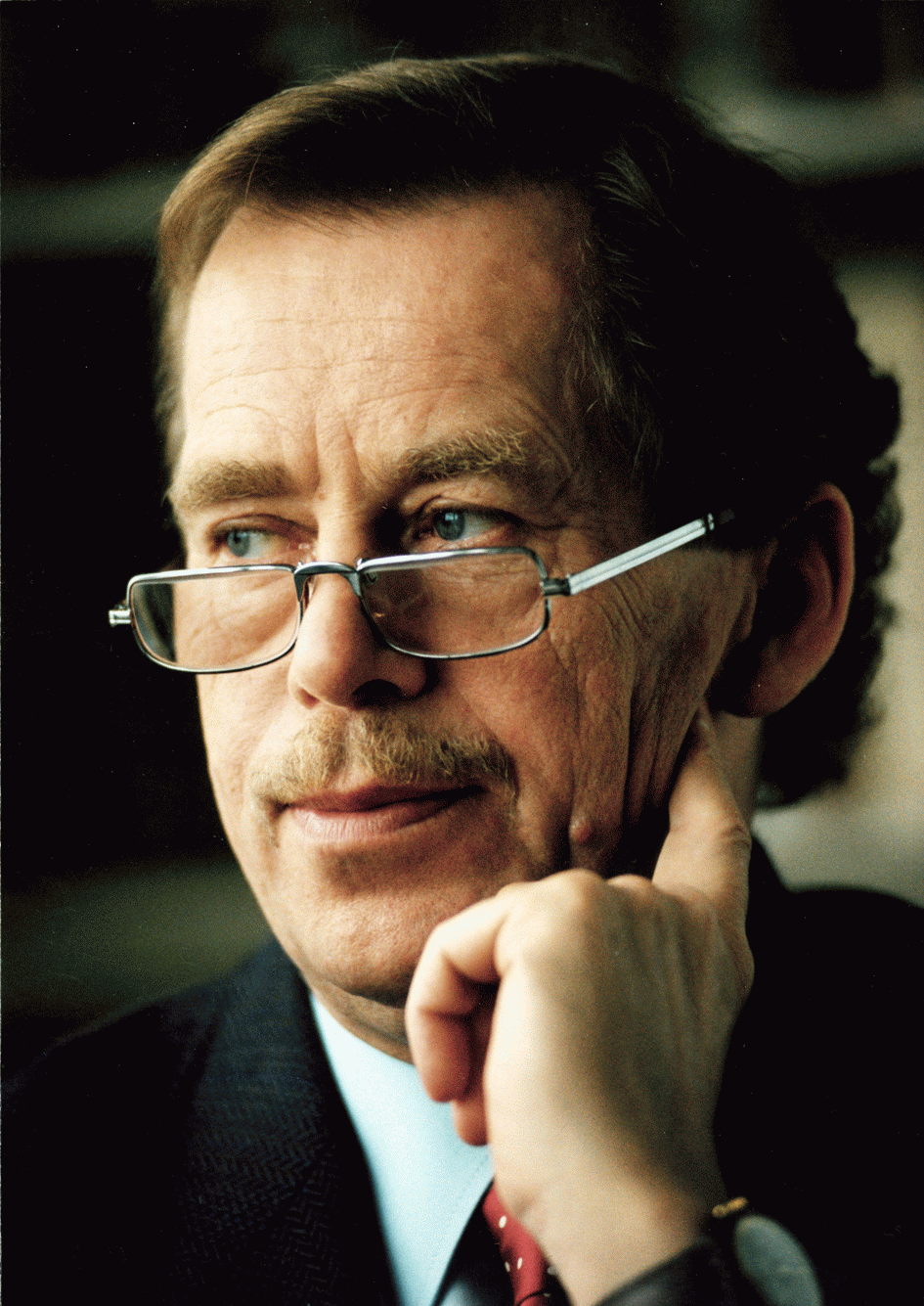
Vaclav Havel addresses demonstrators in Prague in 1988. Picture: AFP

PJ Media readers know why we mourn the passing of Vaclav Havel. On this site, Michael Ledeen beautifully laid out the reasons why the world knows it has lost one of its greatest leaders. Ledeen put it in these words: “he was one of a handful of people who changed the world by fighting totalitarian Communism and then, having defeated it, inspired his people to rejoin the Western world, embrace capitalism, and support democratic dissidents everywhere.”

But now that almost a week has passed since Havel’s death, some on the Western Left have decided to let their true feelings about Havel out. Despite having to give some lip service to Havel’s integrity and what he accomplished, these men of the Left quickly get to what they really think: Havel helped destroy the great ideal of Communism as a worthy goal, and for that, he cannot be forgiven.

The most egregious is the blog in the British paper The Guardian. The headline to Neil Clark’s article reads, “Another Side of the Story.” Clark immediately ties Havel up with another individual who has just passed way, Christopher Hitchens, whose “consecration” he strongly objects to. For Hitchens was, he writes, “ another ‘progressive’ opponent of the communist regimes of eastern Europe who found favour with Washington’s neocons.”

Clark does not question that Havel was “a brave man” who stood up for his views. That he cannot deny. It is Havel’s views, and his anti-Communism, that he detests. For Havel, he writes, did not help make his country “and the world, a better place.” In particular, denying everything we know about the nature of Stalinism in Eastern Europe — the repression, the bureaucracy, the lack of necessary consumer goods to lead a decent life, the ever pervasive secret police — he faults Havel for the following:
Havel’s anti-communist critique contained little if any acknowledgement of the positive achievements of the regimes of eastern Europe in the fields of employment, welfare provision, education and women’s rights. Or the fact that communism, for all its faults, was still a system which put the economic needs of the majority first.
Surely Mr. Clark must be kidding. Has he not read any of the scores of books revealing the nature of life under what his comrades then called “really existing socialism”? Does he not realize that all these so-called “positive achievements” were there mainly in the minds of the state and Party propaganda apparatus, and that the only people to have them were the Party’s apparatchiks? Does he really believe that communism put the needs of “the majority first”? What accounts, then, for the scores of brave crowds who swept Havel into office, and who openly taunted the regime’s spokesmen as liars and no different than the Nazis who ruled before them?

Clark does not stop with the above. In true Communistpeak, he attacks Havel as “the son of a wealthy entrepreneur,” in other words used by the Maoists of the day, a “capitalist roader.” How dare the son of a bourgeois merchant becomes a national hero? Havel, to Clark, as to the comrades who ruled for decades, had no right to power, since he came from the hated capitalist class.

Clark comes up with statistics meant to prove how life became horrible in the Czech Republic after privatization. He cites a study that one million died due to health problems which resulted. We see no statistics about how many died during Communist rule, both in political prisons or from the polluted lakes and rivers and air from uncontrolled industrial pollution, which under Communism was a concern no government addressed. And horror of horrors, there is now “income inequality” in the Czech Republic. Certainly, Communism took care of that problem. All were equal, and shared the scarce resources available, making everyone poor except the Party rulers.

Even worse, Havel had the temerity to support “the NATO bombing of Yugoslavia in 1999,” and then “sided with the rightwing Republican hawks on Iraq.” As we look at both cases, it is clear that Havel had it right both times. NATO intervened to destroy massacres carried out by the Serbs under the leadership of the last brutal ruler of post-Tito Yugoslavia, and under the Bush doctrine, the Iraqi people were freed from Saddam Hussein’s tyranny. Clark ends by saying we should “look at the bigger picture,” and realize how Havel supported the killing of innocent men, women and children” conducted by “western military adventures he supported.”

Writing at The Daily Beast, Geoffrey Robertson also is displeased with Havel, but even more displeased with the fact, as he sees it, that “the American right has claimed him as their own,” while in fact, he believes Havel wanted only to “balance socialism and freedom.” Havel, he argues, wanted most of all “to lift the Stalinist miasma that had wearily settled over Czechoslovakia,” so that in its place there could be created “the democratic socialism in which he believed.”

Unlike Clark, who thinks Stalinism was good for the Czech people, Robertson knows it was bad, but claims that Havel was himself a socialist. Robertson at least knows how bad life was under Communism, and how repressive the government was. A supporter of Czech dissidents at the time and of their Charter 77, he tells us how “its leading members were sacked from their jobs” and later “arrested on charges of ‘unlicensed trading.’”

Certainly, Havel talked about “socialist legality,” a mechanism for showing how the regime ignored its own vaunted standards, which never meant much. But Robertson writes that “Havel’s presidency was plagued by…the difficulties of keeping any socialist faith at all in a free-market free-for-all.” And Robertson shows his own, but not Havel’s, disappointment that the Czechs wanted “guidance in contract law and in the conveyancing of private property.” In other words, having ended communism, they failed to move on to the kind of socialism favored by Robertson.

Robertson, unlike Clark, honors Havel for things like support of the NATO intervention against Yugoslavia, which he writes “was an influential contribution to the evolving principle of humanitarian intervention,” and he honors him for standing “with Sakharov at the head of the pantheon of people prepared to sacrifice their own liberty so others could enjoy theirs.” But he faults him for being unable to “reconcile his beliefs in both socialism and freedom.”

In 2002, the writer Joshua Muravchik wrote a book about socialism’s failure called Heaven on Earth:The Rise and Fall of Socialism. On the book’s back is a blurb from none other than Vaclav Havel, who wrote: “I have always been suspicious of people who claim to have the key to heaven on earth. This book shows why.” Muravchik’s book is the story of the failure of any form of socialism, not just its Soviet style variant. Would Havel have endorsed its central conclusion if he still was a socialist?

In both the case of Neil Clark, who believes Havel was bad for destroying communism, and Geoffrey Robertson, who is sad that he didn’t bring democratic socialism in Communism’s place, you have the two poles of Leftist criticism of Havel. They amount to sadness that the socialist alternative to democratic capitalism ended with the destruction of the Soviet client states. That tells us more about the writers of these pieces than it does about Vaclav Havel.

Reading Václav Havel from His Jail Cell

By Daniel Flynn
http://frontpagemag.com/
December 20, 2011

The curtain came down on the amazing life of the playwright-president this weekend. Václav Havel, the Czech dissident who helped oust the political leaders who imprisoned him, died at 75 in his country home in Bohemia on Sunday.

Havel was the last president of Czechoslovakia and the first president of the Czech Republic. What he didn’t do in both offices far outweighs anything that he did do.

Born into privilege in 1936, Václav Havel lived under persecution for the better part of his years. The Communists expropriated his family’s property in the ’40s, blocked his education in the ’50s, banned his writings in the ’60s, and imprisoned him in the ’70s and ’80s. If ever a man had cause for retribution, Havel did. Yet, when he took power he treated his oppressors the way he wished to be treated—“in a cultured, legal, and civilized manner”—and not in the thuggish manner that they had treated him. “We are not like them,” Havel once told fellow democrats gathered in Prague’s Wenceslas Square. He proved it.

He proved it again upon the breaking up of the multi-ethnic Czechoslovakian state. With the bloody backdrop of the Balkans, Havel wished to preserve national unity and avoid disaster. He succeeded in the latter but not in the former. The idea of war, the first impulse of other national leaders placed in this difficult spot, was not even on the table for Havel. He neither wished to attack his countrymen for seceding nor to preside over his country’s break up. So he resigned his position, becoming Czechoslovakia’s final president. Rather than descend into a second Yugoslavia, Czechs and Slovaks parted as friends. Europe has the peacemaker Havel to thank for this.

Havel shouting “the emperor has no clothes” does much to explain how his rule replaced his oppressors’ rule. “If the main pillar of the system is living a lie, then it is not surprising that the fundamental threat to it is living the truth,” Havel wrote in 1978’s “The Power of the Powerless.” “This is why it must be suppressed more severely than anything else.” Havel “living the truth” proved so contagious to others living behind the Iron Curtain and so threatening to the Czechoslovakian government that they confined him from 1979 until 1984. The example set by one man saying publicly what he believed privately led others to follow suit.

When Havel wrote “The Power of the Powerless,” it could be read only in samizdat form. In the winter of 2006, I freely picked it up, along with other of Havel’s bound essays, in a thriving little bookshop on the Prague Castle side of the Vltava River. At the same shop, I also bought a copy of The Communist Manifesto, which had escaped a samizdat fate in post-Communist Prague thanks to the city’s new live-and-let-live spirit and Penguin Books.

It was in one of Havel’s former jail cells that I first encountered him—not the man himself but this volume of his letters, speeches, and essays. The cell had originally been part of a convent. The mission of the nuns who occupied it, according to the hoteliers now occupying it, “was to serve the poor, ill, maltreated.” The mission of the Communist secret police who evicted them was to make people poor, ill, and maltreated. They certainly did this to Havel.

The room, on the corner of a dark basement hall, proved cozier for me than it had for Havel. The quarters were Spartan but clean. A fresh coat of baby-blue paint, the thermostat overcompensating for the Czech winter, and a plaque noting its most famous guest were all that distinguished the hostel from its previous incarnation. Writing such essays is what landed Havel in the cell; reading them is what drew me there. That he penned his heretical thoughts to paper brought both of us to the same place but under very different circumstances.

Marx and Engel’s manifesto seemed more curio than current. Often it was only by placing the polemicists’ lines in the past tense that they made sense, e.g., “A spectre was haunting Europe—the spectre of Communism.” If the trust-fund revolutionaries felt subversive writing their manifesto, I felt subversive reading it where their followers had turned a house of God into a house of horrors.

Havel, on the other hand, spoke eerily of the present from the past. “Ideology is a specious way of relating to the world,” he noted in one timeless passage. “It offers human beings the illusion of an identity, of dignity, and of morality while making it easier for them to part with them.” Considering the freewheeling nature of present-day Prague, “The Power of the Powerless” reads at times as prophecy. “The specific nature of post-totalitarian conditions—with their absence of a normal political life and the fact that any far-reaching political change is utterly unforeseeable—has one positive aspect: it compels us to examine our situation in terms of deeper coherences and to consider our future in the context of global, long-range prospects of the world of which we are a part,” Havel wrote in 1978. “The fact that the most intrinsic and fundamental confrontation between human beings and the system takes place at a level incomparably more profound than that of traditional politics would seem, at the same time, to determine as well the direction such considerations will take.” Such confrontations toppled the regime in the next decade. “For the real question is whether the brighter future is really always so distant,” he concluded. “What if, on the contrary, it has been here for a long time already, and only our own blindness and weakness has prevented us from seeing it around us and within us, and kept us from developing it?” Havel daring to dream a different reality helped to bring it about.

How liberating to study the game plan for the powerless defeating the powerful from a decommissioned Communist clink!

A prison is a place so terrible that its inhabitants will do anything to get out. A hotel is a place so inviting that people pay to stay there. The transformation of the room I read from symbolized the transformation affected by the transformative personality who once stayed as its unwilling guest. What had been a dreary nation caricatured as the epitome of Eastern Bloc backwardness on a famous Saturday Night Live skit is now a tourist magnet for sophisticated Europeans who marvel at all that architecture, history, culture, and commerce. Havel, among so much else, alchemized a Communist dungeon into a cash-cow tourist trap. Somewhere Marx is frowning at this irony just as Havel had smiled at it.

Václav Havel is dead. One need only visit a free and vibrant Prague to appreciate his life.